30 July 2008

New Fuertes exhibit at the Field Museum


The Painted Bird: Louis Agassiz Fuertes is an exciting new exhibit opening at the Field Museum of Natural History in Chicago in a few weeks. It runs from 12 September 2008—Sunday, 4 January 2009. Several of the pieces on display are the renowned Abyssinia paintings, arguably some of the best works he ever painted and certainly notable in that they were his last. These works were completed during the 1926 Field Museum expedition to Abyssinia (now Ethiopia). Fuertes died tragically just three months after the expeditions culmination.

17 July 2008

Art Show


After a long hiatus and a ton of work that I will soon hopefully post about, my Lab of Ornithology show opens this afternoon. If you're in the vicinity of Ithaca NY, please stop on by the Fuertes room at the Cornell Lab of Ornithology today, 17 July 2008, 5:30-7:30pm. Thanks to Charles Eldermire for the great announcement with my singing Red-eyed Vireo.

06 April 2008

Fuertes Canvasbacks


A quick update on a Fuertes original which sold at auction at Skinner galleries in Boston a few weeks ago. This large Canvasback piece sold for $10,300.

28 January 2008

Fuertes - Red-headed Woodpecker


I stopped by the Joel Oppenheimer gallery in the Wrigley building on a visit to Chicago over Christmas. This gallery is a must see for anyone interested historical natural history art, especially the work of John James Audubon. There are many Havell edition Audubon originals on the walls in addition to the work of many other esteemed bird artists of the 19th and 20th centuries. When I visit every year it is my custom to stroll the galleries, giving the Audubon Havell's there fair attention, after all it is a real rarity to see so many, and so many of the most sought after prints on dispaly in a single gallery. After this circuit I am inclined to beeline for the small gallery at the center of the tiny library corridor. Here in a secluded space, hidden from the eye of most visitors is the collection I am most intrigued by, a selection of originals by the likes of Jaques, Sutton and often a Fuertes or two. This year, the apple of my eye was a new Fuertes original on the east wall, a classic portrait of a Red-headed Woodpecker. The gallery staff was kind enough to send me a photo of the piece (which like all of the originals here are for sale, the Fuertes for a cool $17,000). The next time you are in Chicago don't miss a chance to visit this gallery and check for some new gems on the library walls.

Fuertes original - Auction complete


A final update of the Kingfisher and Grey Heron Fuertes auction on eBay. The final selling price of $6000 surprises me, mostly because of the lack of any provenance information in the auction posting. I imagine the buyer, and competing bidders were aware of some background information about the piece which led them to bid so high with confidence. I will continue to poke around in the Fuertes resources here at Cornell to try and unearth some more details about this, and some of the other paintings of European birds I have seen attributed to Fuertes .

25 January 2008

Zickefoose - How to build a watercolor


One of the first things which excited me about Julie Zickefoose's blog were her occasional posts chronicling a work in progress. Now and again she takes her readers all the way through her daily painting activities and details a piece from start to finish. Birding magazine picked up on this a few issues back when Julie was asked to provide a cover painting. On the ABA website I found this very nicely laid out expose entitled 'About the cover painting'. Keep an eye out on the Birding Magazine archives in the future for further incarnations of this great column.

Fuertes original - Update


UPDATE: With 2 days to go in the auction, there are four bids bringing the current price up to $409. I have been searching in vain over the past few days for a reproduction of another painting by Fuertes sold at a very reputable gallery a few years ago. It was a painting of Great Tit's, also from England and very similar in style to this Kingfisher. I had hoped to compare the style and signature but I have unfortunately not been able to locate it.
Ahah...I have found it, unfortunately a very poor resolution version. Have a look.

22 January 2008

Fuertes - Purported original on eBay


A scan through the eBay offerings this morning yielded a listing for an advertised Fuertes original. I am not at all convinced that this painting is the real thing. As with a few others from the past there are many elements that just aren't quite right. The overall style, brush work and even subject matter are aberrent and the signature appears to be a crude facsimilie of the cursive signature line used for the bulk of his painting career. The painting depicts two European species, the Common Kingfisher and the Grey Heron. Take a look at these images and the auction on eBay and please feel free to register your own opinions in the comments section.

12 January 2008

Upcoming show


I am working on material for a show in a few months at the Lab of Ornithology in Ithaca. Here is an announcement from the Lab of O calender of upcoming events. I thought this might be a good time to get back to this blog which hasn't had any life for the last several months. Keep posted about new work from my drawing board and try to make the show in Ithaca in July if you can. Take a look at the new Cornell Lab of Ornithology Education page with a highlight on the Auditorium Gallery to see the whole public announcement for my show.

10 September 2007

Fitz's Wood-Wren


A very qick post with a new painting pulled from the archives of the Auk on
SORA, the Searchable Ornithological Research Archive. This plate painted by John W. Fitzpatrick accompanied the description of this new species from Peru, the Bar-winged Wood-Wren (Henicorhina leucoptera) in 1977, in the Auk 94: 2, 195-201.

05 September 2007

Fuertes Originals for sale


A meander through the google search returns for "Fuertes painting" last night yielded a new discovery from a gallery called 'W. Graham Arader'. This painting of Townsend's Solitaire and Mountain Bluebird is the real gem of the bunch. The others available for sale include a few pieces from the Arm and Hammer baking soda card series, (the Flicker and Brown Thrasher*), two originals from Fuertes' first major commission, 'Citizen Bird', (the Northern Mockingbird and Blue Jay) and a few other works that are likely from very early in his career. Take a look at W. Graham Arader III's 'Fuertes Gallery'*Note: a few of the paintings are mis-identified on the website.
The thing I like the most about the Solitaire and Bluebird piece is the variety of postures. The Solitaire is perched in a very interesting, atypical posture. Birds are very subtley animated creatures, especially songbirds, often twisting their heads, craning necks, erecting or smoothing particular feather groups or perhaps fanning the tail as in this Solitaire. Capturing these nuances was perhaps Fuertes's greatest skill. He seemed to portray these attributes with such ease and so naturally that the depictions speak a profound elegance, just like looking at the birds themselves. He translates onto paper, even in gray tones a breath of life, unlike any other artist has. This is quintessential Fuertes.

30 August 2007

Painting of Today - Debby Kaspari


I have an upcoming post in the works featuring the work of Debby Kaspari, for now here is a great painting of Scissor-tailed Flyctachers. Check out this post , and read about the great story behind this work.
Or her whole excellent blog 'Drawing the Motmot'

29 August 2007

Painting of the Day - Jon Fjeldså


Anyone recognize this beautiful image? If you own a copy of the great book 'Birds of the High Andes' by Fjeldså and Krabbe, you might have recognized this watercolor by the Norwegian artist, ornithologist, biogeographer extraordinaire Jon Fjeldså (it is in the inside liner of the book). If you haven't spent any time with this book, you should check it out at the library and take a look. The entire volume is illustrated beautifully by Fjeldså with intricate plates in watercolor and the text is supplemented by his loose, somewhat stylistic ink drawings. Some of Fjeldså's other work can be seen in his Oxford University Press monograph on Grebes of the world and on the occassional cover of the Auk like this one below from 2004.

26 August 2007

Art Auction at Coeur d'Alene


I came across an interesting natural history art auction which took place a few weeks ago at a house called Coeur d'Alene. Take a look at the catalog. A few paintings which caught my eye are this amazing Great horned Owl piece by Guy Coheleach (pronounced Co-lee-ack), and this impressive Moose by Carl Rungius. In upcoming posts, I plan to update you on a few auctions of notable paintings that I have spotted and followed, including a past Fuertes auction which I have not yet written on.

24 August 2007

Featured Artist - Carel Brest van Kempen


Flipping through my blog lists a few nights ago, I visited Carel Brest van Kempen's blog Rigor Vitae . Check out his extremely imaginative, exquisitely detailed work on his blog as well as on his webpage . The painting which struck a chord with me on this visit to his blog is this fanastic image of a Ferruginous Hawk. The detail in the rock face, lichens, twigs, grasses as well as in the bird itself is stunning. This piece in particular reminds me very much of the work of Raymond Harris Ching . I can only imagine the hours and hours of work it must take to render even the smallest patch of vegetation or scratch of earth. For a bit of insight into the artist, there is an interesting video touching on his goals as conservation minded artist linked from a recent post on Rigor Vitae.

10 August 2007

When the painting tells a story


While breezing through the stacks on a trip up to the library today I randomly spotted Johnsgard's monograph on the Quetzals and Trogons
of the world and had to pull it down to quickly leaf through the plates. The artwork used in this book is quite ecclectic running from contemporary to classical. Several of the plates are beautiful, historically signifigant pieces from John Gould's 1858–1875 Monograph of the Trogonidae. The rest are a mix of a handful of contemporary artists, including Dan Lane, John P. O'Neill and Dana Gardner. One plate in particular caught my eye specifically regarding a goal I have been cultivating for my own work of late. Here is Dan Lane's painting of a Bar-tailed Trogon family group. This is an excellent composition communicating a simple story about the lives of these birds at the nest, the male on sentinel, the female visiting the nest to feed a green caterpillar and of course the chick greeting its parent at the nest mouth. This kind of story telling is both visually interesting and intellectually stimulating.

09 August 2007

Dan Lane's new Cnipodectes in the Auk


I spotted the new issue of the Auk this morning with a beautiful painting by Dan Lane on the cover. This is an example of perhaps one of the most exciting types of frontispiece images to behold... an image of a newly described species. Take a look at BioOne if you have access, or try to get it through a library online collection from the same link another time to read the species description.
For the intrepid, here are some hints for finding this new species in Peru.
Here is another great piece by Dan, a plate from the forthcoming Birds of Peru. Dan also has a website highlighting some of his work in watercolor as well as black and white ink drawings you may have seen in the rotating bird art on Birding on the net .

02 August 2007

Fuertes sold on eBay live auction


A few days ago a beautiful Bald Eagle painting sold on an eBay live auction. Originally estimated to sell for $3-$5,000, the final sale was for $6,750. I have not had a chance to research a place where this piece may have been published. Anyone out there recognize this piece? Take a look.

26 July 2007

Return from Alaska


Back home at last. After 7 great weeks on the road, I have returned to my Ithaca, NY home. Alaska is a fabulous place with unbelievable opportunities for exploration. I will be posting in the upcoming weeks about some of my best birding experiences, especially as they translate onto a canvas. For now though, take a look at my 'travelogue'from the journey. I am working now on a series of backdated posts from the trip south so it will hopefully be more interesting as I add more. On the adjacent pages you can also read about the travels of my audio archive colleagues.

18 June 2007

On the Road


At long last, I have found the tiny smidge of time and energy to post to my poor blog, which has received so little attention from me since the early spring. I am in Deadhorse Alaska on the north slope working on the last leg of my last journey of the year. I have had nice success of late with digi-binned photos of the birds that we are here in Alaska filming. Upon returning home, I hope to turn several of my shots into paintings. Here is one I snapped through my bins yesterday of a pair of beautiful Spectacled Eider.

16 March 2007

More hybrid warblers


I've completed a flurry of painting along with the with the general squall of activities in my life of late. I am on the road right now in south Florida on the road recording and filming for work at Macaulay Library. We're seeking footage of some of the real specialties of Florida like Limpkin, White-crowned Pigeon and later on in the spring Gray Kingbird. Right now I am contentedly working on filming the abundant exotics around lovely sprawling Miami. This morning we worked on Common Myna, Muscovy Duck and some fabulous Monk Parakeets.
My posts will be even more sporadic than normal in the next few weeks, but I will be sketching, so hopefully upon my return in mid April, I'll have new work to share.
Here is my most recent piece, a plate of Lawrence's, Sutton's and Brewster's Warblers. This piece will acompany the Junkin's Warbler painting in Living Bird Magazine. Later I'll work on a post about the process of painting these birds.

04 March 2007

Tinkering on the Junkin's Warbler

Click on the image to enlarge and read the comments.

Last weekend with some extra time before the painting needed to be shipped, I was able to tinker with some areas in the piece that had been nagging at me. Here is a bit of description of the changes and additions I made to the final piece, with a side by side view, a larger look at the pre-tinkering view, followed by a larger look at the final tinkered version.

Side by Side (sorry for the major light difference)

Pre-tinkering

Final piece

The biggest and most effective change I think comes from the alteration of the highlights in the belly and flank and where the wing meets the flank. I wanted to see the shadow below the wing, where the primaries lay down over the body, but I think I was a bit overzealous in the first effort. The flank highlight and reworked belly shadow really gives the body of the bird more depth. Previously, there was a flatness to this are that I was really dissatisfied with.
This experience shed some light on another issue with my painting as well. I completed the painting at night, under a good incandescent light on my drawing table but came to realize just how different the highlights and shadows were reading in natural light the next morning. For certain aspects of these paintings, I am realizing how much of an imperative it is to be able to work by daylight. Unfortunately this is a real challenge while trying to complete this work with mostly evening hours to spend.

03 March 2007

Keulemans and the Shrike-like Cotinga


Browsing in the library a few days ago I found a small book called Bird Illustrators by C. E. Jackson. The book wasn't striking upon initial inspection (lacking a full compliment of color reproductions). Where it excels though is in the wealth of biographical information on many of the pioneers of the 16th and 17th century natural history illustration. As I leafed through, spotting a few notable names like John Gould, Edward Lear and Archibald Thorburn, I found a chapter on an artist that really caught my attention, John Gerard Keulemans. I first spotted the work of Keulemans a few years ago in a short paper from 1880 in the proceedings of the Zoological Society of London. When I sought out the paper I was on a quest to find out as much as I could about a particular species of Cotinga. I'm occasionally caught by the bug of a particular bird which I can't seem to get out of my system until I've tracked down as many resources as I can. Trekking down the literature trail, collecting as you go can be a really fun excercise, especially these days when so many ornithological resources are available for free from places like SORA and OWL.
In this case the bird under my spotlight was the Shrike-like Cotinga (Laniisoma elegans). Intrigued by the bird itself, a beautiful and striking species, (check out this specimen in the American Museum of Natural History that I photographed last year). I was further spurned on by listening to Ted Parker's recording of the bird from the 1980's. The bird has a fantastic, ethereal voice, is hard to find and relatively poorly known.
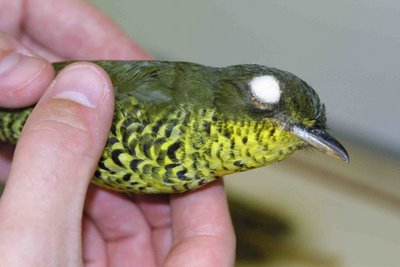
Poking into the literature, I located that early reference for the 1880 paper by Sclater and Salvin titled 'On new Birds collected by Mr. C. Buckley in Eastern Ecuador'. In it, I found this fantastic plate by Keulemans (at the very top of the post). In the paper, details of Buckley's experience with this species are scant, but perhaps the most intriguing piece involves the discovery and collection of two nestlings with the female adult. Of the nestlings he writes, "The plumage is most remarkable: the upper surface including the whole of the head is of a cinnamon color spotted with black, each black spot on the head being tipped with white; the under surface is black, banded with narrow white bars. From the top of the head proceed fine black filaments more than an inch long, each tipped with white." All of this excellently depicted in the lithograph. The coolest part of the story is that the nest and nestlings of this species have never again been found for reexamination and the specific purpose of the extremely long natal plumes in nestlings are still unknown.
Lastly here is a great plate from David Snow's monograph 'The Cotingas' showing the same view of a chick and adults.

23 February 2007

David Sibley original paintings available


On David Sibley's homepage, he has occasionally had original paintings available for sale. I happened upon it today and found a nice selection of pieces from his “Sibley on Birds” syndicated column from between 2002-2005. Take a look at the paintings available on the Sibley gallery, all for sale for $1800. This Yellow-breasted Chat is a real standout with a simple, elegant depiction, highlighted by loose habitat elements.

18 February 2007

Painting the Junkin's Warbler


A few weeks ago, I began tracking down resources and planning for a painting to appear in the Living Bird magazine. This painting is to accompany an article on the discovery last spring of a hybrid Parulid which was netted in western New York by David Junkin. You can check out some photos of this species and read the details about the capture at David's mystery warbler site.
With it's mosaic of characters, this bird was NOT identifiable to species. Photos were taken to attempt later ID and feathers were collected for genetic analysis. The photos were sent out to the ID Frontiers listserve where various accomplished birders from around the country tossed in their two cents about the identity of this bird. It was very quickly determined that the bird was most likely a hybrid, but of which two species? Dr. Irby Lovette at the Cornell Lab of Ornithology and his lab set out to make this determination leaning heavily on their labs extensive work on Parulid genetics from the past. In the Living Bird article, the Junkin's Warbler will be presented just as it has been to me... unidentified. Readers will be given their own opportunity to make a determination in the form of a contest. Take a look! Which two species does it look like to you? In the spring issue of Living Bird, and I presume on the Cornell Lab of Ornithology home page, you'll find an opportunity to share your opinion.
The image below is a composite of various stages of the painting in progress. One of the interesting things about this piece was working from just a handful of photos of a bird in the hand with various characteristics clear in some and blurry in others. I began with a sketch of a generic Parulid, purposely choosing a posture that was not meant in any way to be diagnostic. Once the posture was finalized, I transferred the sketch to watercolor paper using tracing paper by darkening the back side with graphite and retracing over the outline, rubbing a ghost image to the thicker watercolor paper. In this case, I used 300lb Arches cold press. Next I painted the outline of the bird in very light neutral tint watercolor and then moved on to the wing. To get the proper highlights in the wing I employed many, many layers, beginning with light yellow and slowly adding the darker olive greens of each feather group, slowly blending as I went. The head, beak, body tarsus and foot and tail, all progressed very quickly finishing with the birds eye as I always seem to insist on. There is something very satisfying about bringing the bird 'to life' at the end of the painting process by painting the eye.
One last detail. As I alluded to earlier, I am not privy to the 'answer' to the puzzle of which two Parulid species are the parents of Junkin's Warbler. The authors wished for my eye to remain unbiased so that the true identity would not unconciously shine through influencing the painting one way or another. I remain very intrigued by the mystery and look forward to the upcoming contest and unveiling in a few months.

07 February 2007

Ewoud de Groot website


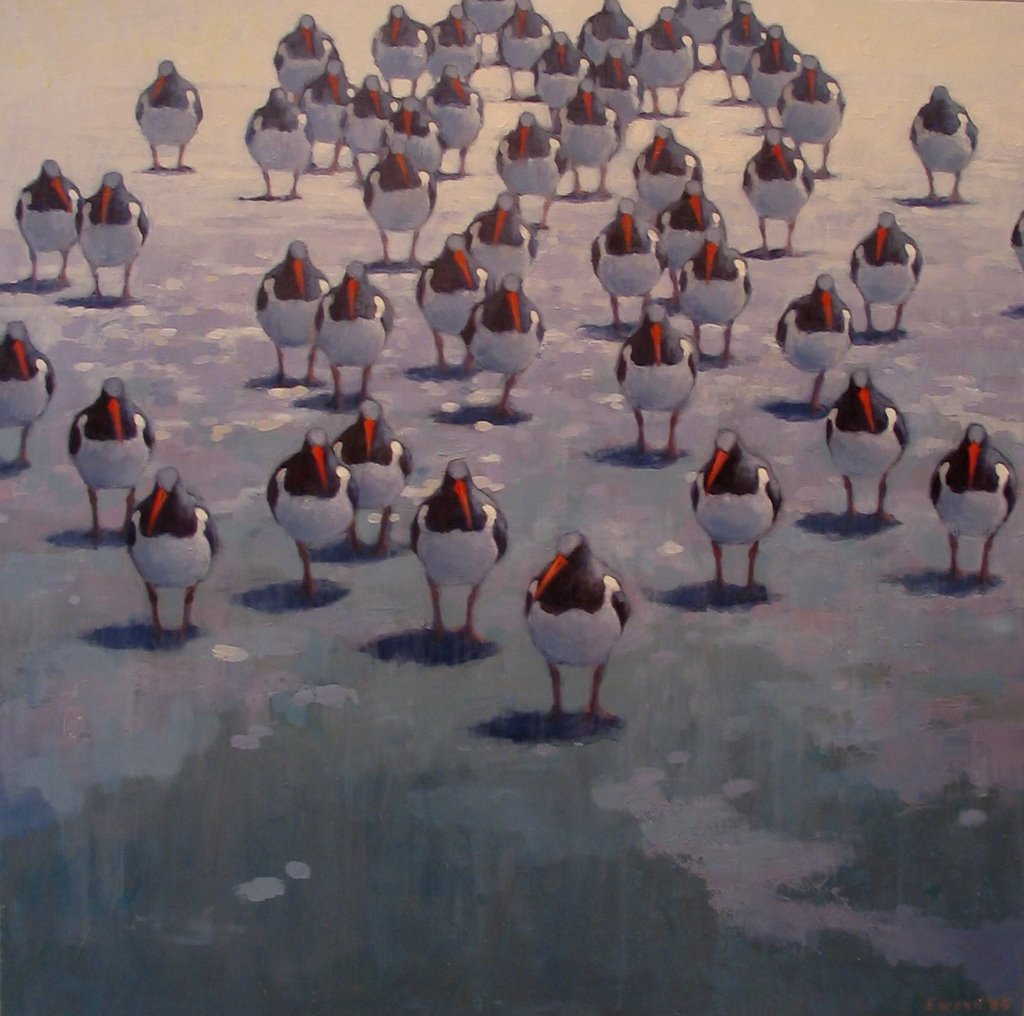
I received a nice email from Ewoud de Groot in the Netherlands in response to my post about his Oystercatcher piece in the traveling 'Birds in Art'. He sent the address for his website. Check out EWOUDBIRDS where I was excited to find a whole series of fantastic Oystercatcher pieces and many more like the Little Tern piece above.

Update: 16 February 2007. Ewoud de Groot's website appears to be down at the moment...hopefully to return soon.

05 February 2007

Birds In Art - Arnot Museum


This past weekend a few friends and I took a trip down to Elmira, New York to visit the Arnot Art Museum. The Leigh Yawkey Woodson Art Museum 'Birds In Art' special exhibit is showing there through the 18 February 2007. This is the final stop of the 2005 traveling tour. There are around 60 pieces in all with a few highlights like the spectacular "Resting Oystercatchers" by Ewoud de Groot from the Netherlands. This Oil on Linen piece was a real eyecatcher in the exhibit entrance hallway and turned out to be the real favorite of the whole show.

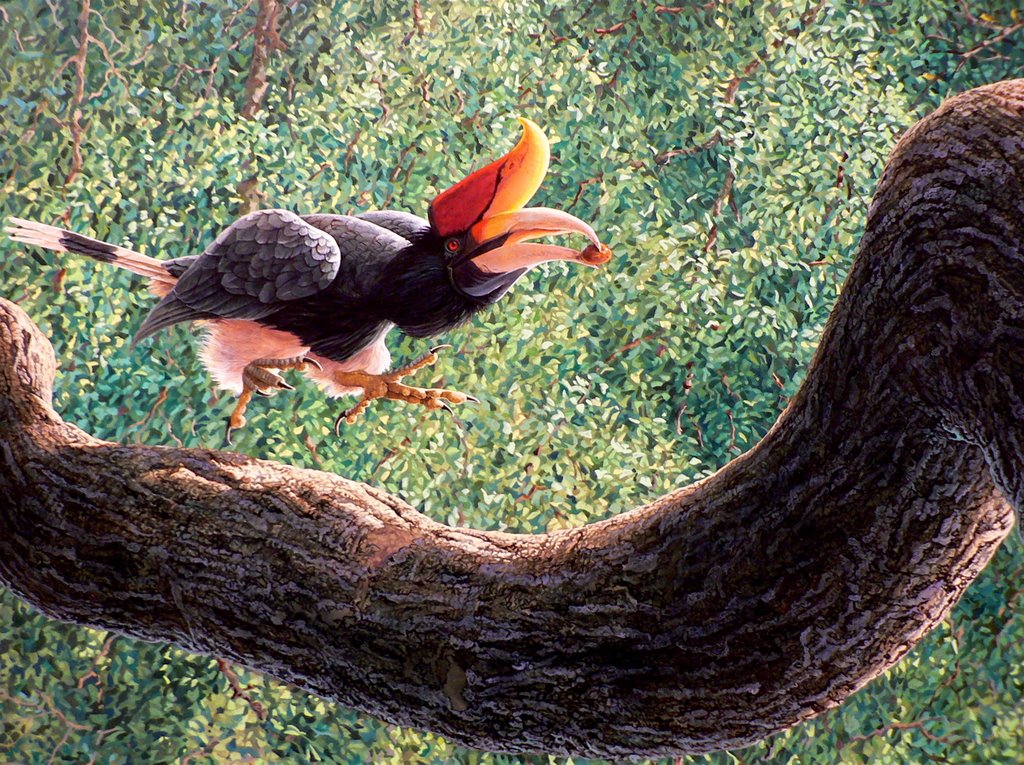
Another favorite was the malaysian Rhinoceros Hornbill acrylic by the Utah based artist Carel Brest Van Kempen. Carel has a great blog called 'Rigor Vitae A view through the eyes of a nature artist'


Please take the time to head down to the 'Arnot Museum' in Elmira if you have the chance. The admission is free on Saturday and Sunday and there are only two more weekends left to catch this show before it closes forever. Thanks very much to 'The Contemplative Nuthatch' for the photo above...as my camera is truly on its last legs.

29 January 2007

The evolution of an artists signature - Fuertes


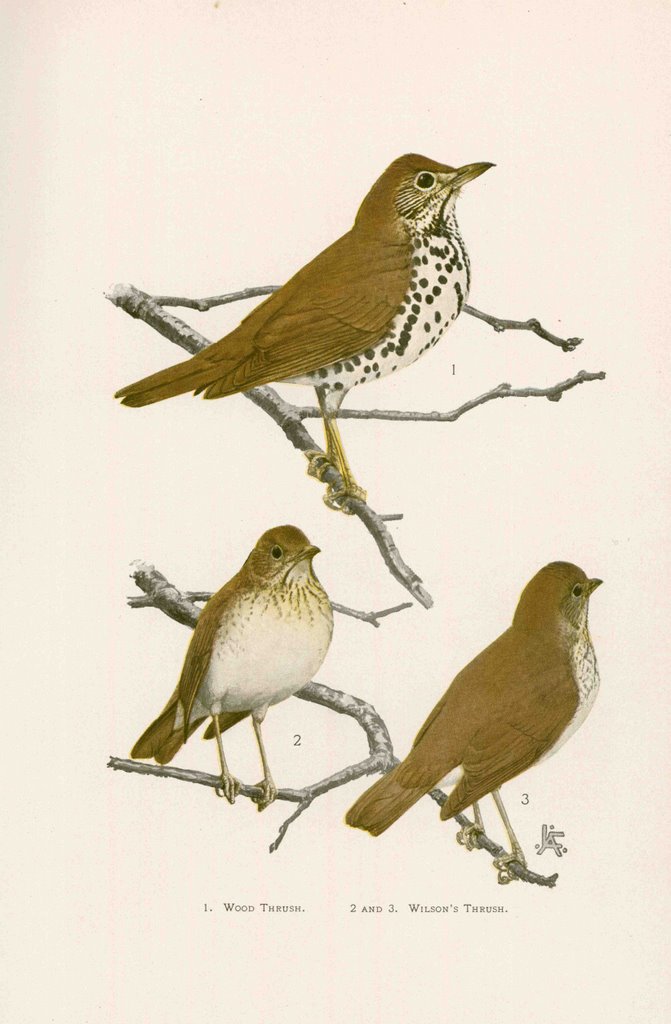
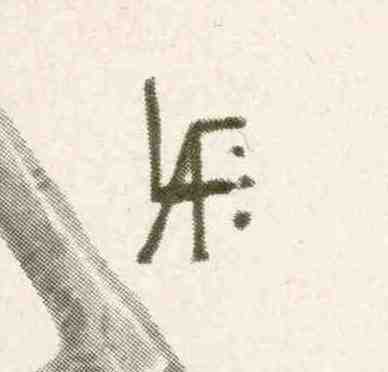
Perusing the early published paintings of Louis Agassiz Fuertes from the pages of Birdlore not too long ago, I noticed an interesting progression in the form of the artists signature. The first of Fuertes's works I can find in Birdlore were in volume 6 in 1904. These first paintings are signed with 'traditional' script. The bulk of Fuertes's work, through the years are signed in this manner, almost always with a characteristic, neat, compact cursive style, most often in watercolor and occasionally in pencil. This warbler plate represents that commonly seen signature, in this case simply the initials LAF, in others, like the Wilson's Warbler plate from a few posts ago, his entire name is signed. After a few years and publication of all the the Fuertes and Horsfall warbler plates, a new, but short lived series of signatures is seen in Fuertes's work. The development of and rational for the use of this monogram-type signature is a mystery to me. I can surmise that Fuertes was simply experimenting different manners of signing his work. The signature on the Thrush plate below is somewhat reminiscent of the early, 15th century natural history artist Albrecht Dürer....and I'm sure like many other artists. It seems, the development of a signature monogram is a common practice for many artists.
Lastly, in this Robin plate, published in the very next issue after the monogrammed Thrush plate, Fuertes has again changed the signature to simpler monogram.
From this point forward, in the later pages of Birdlore, Fuertes seems to go back to the traditional script signature. This signature seems to have prevailed as he proceeds to use it most frequently for the rest of his career.

24 January 2007

Potoos - one stump next to another

Here's another Birds in Art post... an interesting comparison this time. Flipping through the 1994 catalog, I came across this first piece by John P. O'Neill, Long-tailed Potoo. It is reminiscent of a Fuertes painting of the Common Potoo from the Mexico expedition of 1910. I am curious whether O'Neill's piece was influenced at all by Fuertes. O'Neill paints the Potoo in a more typical, deeply restful state with the eye mostly closed. Fuertes chose the more alarming - open-eyed look, more often seen near dusk when the species is readying to head out in search of nocturnal prey. The Potoo's - Family Nyctibiidae are a curious group of birds. I've sometimes described them as a cross between a hawk and an owl. Very secretive and cryptic by day, Potoo's often roost on a broken snag, adopting a distictive head-up resting posture which renders the bird nearly invisible.

19 January 2007

Featured Artist - John Sill


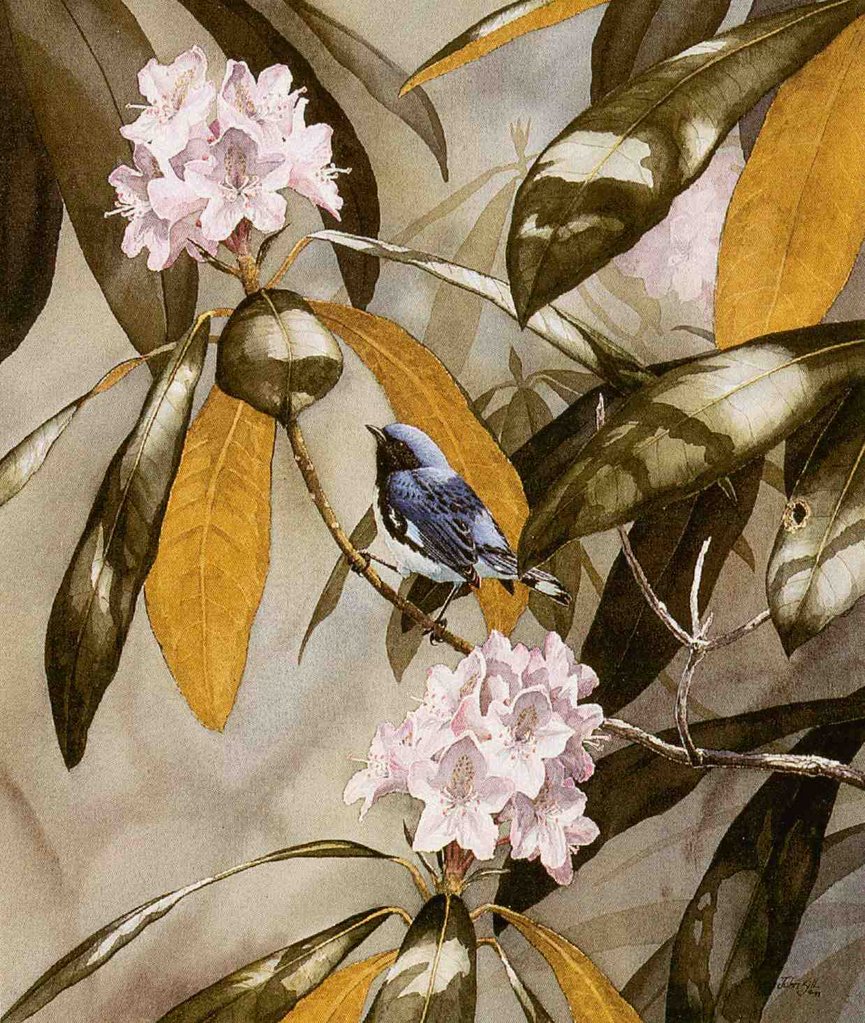
John Sill from North Carolina was one the first bird atists whose work I really scrutinized as a kid. I received slews of bird related gifts once my family got wind of my adolescent love of birdwatching. One of those gifts was often the Mass Audubon Bird ID calendar, which John Sill illustrated for many years. This beautiful composition of Black-throated Blue Warbler framed in a rhododendron grove caught my eye in the Birds in Art catalog. This piece epitomizes for me the reason watercolor is such a fantastic medium for bird art, with the beautiful clear washes of the rhode leaves, in sunlight and shade, the hinting of leaves further back behind and above the bird and the general soft clarity of the transparent washes.
An aside...If the 'BIRDS IN ART show'....the awesome traveling exhibit of the Leigh Yawkey Woodson BIRD Art museum sounds interesting and you are any where near central NY, I recently discovered that it is showing RIGHT NOW, through 18 February at the Arnot Museum in Elmira, NY. Look here at the 'Arnot Museum page'

17 January 2007

Painting of the Day - McQueen


To splash a bit of color up on the page, I am posting this beautiful piece by Larry McQueen. The Leigh Yawkey Woodson Art Museum 'Birds in Art' series is a great series of simple inspirations to peruse now and again. The annual competition selects pieces from artists who submit an entry or two per year and honors those chosen by publishing the selections in a beautiful book each year, as well as honoring a single master artist per year. The library here at the CLO has ALL of them, going back to the early 1980's. Occasionally I steal away up to the window seat in the library and leaf through the pages, gleaning insights or simply for pure entertainment. This McQueen piece satisfies the goal of the artist as printed in the caption...the essence of the Indigo Bunting is captured beautifully.

15 January 2007

Bird Feet


Many posts ago I mentioned the topic the rendering of bird feet. I was working on the feet of the Screaming Piha and thought about opening up a blog discussion purely on feet...pitfalls and triumphs, techniques and schools of thought. Feet are an interesting part of the bird and are often a challenge to represent. First of all lets look at feet...Passerine feet to start, from a scientific perspective. The tarsi and toes of a bird can tell you a lot. Patterns are taxon specific, starting with toe arrangement of course, but even the actual scute morphology, size, arrangement and number are diagnostic. Here is a diagram from my old ornithology notebook with a few scutellation patterns.
The quality isn't great and the text is difficult to read. The scutellation types shown here are:
PYCNASPIDEAN: Phytotomidae, the Plantcutters, a small neotropical group
EXASPIDEAN: Tyrannidae, the Tyrant flycatchers
ENDASPIDEAN: Dendrocolaptidae, the Woodcreepers, a large neotropical group
HOLASPIDEAN: Alaudidae, the Larks, (note the long back claw)
TAXASPIDEAN: Rhinocryptidae, the Tapaculos
BOOTED: Turdidae, the Thrushes (and many others I believe)
LAMNIPLANTAR: Fringillidae, finches (and also many others I believe)
Toe length and claw curvature is another aspect that needs to be paid close attention. Take a look at this page out of Fuertes's Citizen Bird illustrations to see a wide array very nicely rendered foot types.
To be continued.

Today, Tuesday 16 January 2007, I tracked down the figure from VanTyne and Berger's Fundamentals of Ornithology. Here is a much better resolution scan, with the facing page infor for those interested.

19 December 2006

Art of the Field Guide Plate


I guess its that time of year...I have been under the weather for the last few days and haven't been able to muster a post.
I have been thinking for a while about the field guide plate as an art form. Not typically regarded as a form of natural history art worthy of it's own designation, the field guide plate is certainly ubiquitous, and recognizable. I have a real nostalgic connection with the first generation Golden Guides, with plates by Arthur Singer. This was my first field guide and it will always be a classic in my mind. If you have the chance though, check out the second generation, written and illustrated by James Coe a few years ago. Coe's plates in this reinvigoration of the Golden Guide are some of the best I have seen. Take a look at this Warbler plate. These plates combine spot-on species portraits, habitat characters and natural history elements seamlessly in attractive compositions. This type of plate combining birds and their habitat, juxtaposing the understory with the middlestory, transitioning to a different habitat in a different quadrant of the plate has a really nice effect. Contrast this with a more prototypical plate by Larry McQueen. The second plate here is one of McQueen's efforts for the forthcoming Birds of Peru. Just a hint of habitat shown on the perches with more birds per plate are the biggest differences. Look closely at the variability of perch angles, supremely accurate posture representation and interesting depictions of differing, yet diagnostic facial guises. McQueen is truly one of the best painters working today, and I can't wait for a chance to be able to study all of the plates in Birds of Peru when it comes off the presses.

15 December 2006

Fuertes - Elliot Coues, the early mentor


After Fuertes had won the attentions of Elliot Coues, one of the premier ornithologists of the late 1800's, he received a showering of inquiries from the rest of the community. Impressed with Fuertes's paintings, Coues had showcased Fuertes work at the AOU in 1895. He told him in a letter, "I brought your name prominently before the American Ornithologist's Union by exhibiting about fifty of your best paintings and talking about them". This lead to one of the best early opportunities for Fuertes from Walter Adams Johnson who had recently launched a new ornithological magazine called "The Osprey". Fuertes was first published there, on the cover in 1897. Here is the cover with a Fuertes's grayscale painting of Eastern Screech Owl.


The attention received here and interest in his talents, while still such a young man, undoubtedly did wonders for establishing Fuertes as a sought after artist amongst the ornithologists of the day. Soon Fuertes's talents would win him bigger, higher priority jobs, all this while still a busy undergraduate at Cornell.

13 December 2006

Horsfall Prints from Chapman's Birdlore - Continued

As promised, here is the same plate as published in Birdlore in ~1904 and later in Chapman's Warblers of North America.


When I realized there was a discrepancy between the Fuertes plates and Horsfall's, I shifted my interests squarely onto the 4 Fuertes originals. I dug a bit more into Horsfall and his career, learning a bit about his life in this 'Biography' . I had suspicions that the auction house was indeed aware of the fact that these paintings were actually not painted by Fuertes. Selfishly though I focused my attentions on the auction for the plates I was most interested in.
As I wrote in an earlier post 'scroll down from here' , on the day of the auction, luck was not on my side and all of the plates that I bid on crept out of my price range (Bidding via telephone was a real thrill though!). Afterwards, after I actually heard the auctioneer attributing the Horsfall plates to Fuertes, I felt I had to pass on what I knew. I sent them a letter reading...

Dear...
I participated in the auction of several original bird paintings a few weeks ago. Since then, I have confirmed my suspicions about some of the pieces that were up for auction. All lots 155, 156, 157, 168, 169, 170 were published originally in 1903 in a series of articles in the early Audubon Society publication Birdlore, and then again in a book by Frank M. Chapman called 'The Warblers of North America' in 1907. Two artists contributed paintings for both of these publications, Fuertes of course, but also an artist named Bruce Horsfall. Lots 157, 168 & 169 appear to me to have been painted by Bruce Horsfall, not L. A. Fuertes. Look for the BH monogram.
You may be aware of this already. If so, please disregard. I thought I would share a bit of my research into these works, especially in case you were not aware of this apparent discrepancy.

Please feel free to contact me if you are interested in any further details.
Benjamin
...

A while later, I received this very short, rather unsatisfying response...

Dear Mr. Clock,
Thank you for the information and participation in our auction.
Sincerely,
...
I still am not sure what the gallery's next step was, but it certainly would have been nice to have been informed. Check and double check provenance is the take home message. I do know that AskArt.com currently lists the Horsfall's in the recently auctioned Fuertes paintings section that you have to pay dues to view.

Stay tuned in a later post for some new and interesting tidbits I unearthed while digging back into Birdlore Volumes 1-10 starting in 1899.

For Fun, here is the first Fuertes piece ever published in color in Birdlore, again derived from a grayscale plate, colorized during the printing process.

12 December 2006

Horsfall Prints from Chapman's 'Warblers' & Birdlore


Robert Bruce Horsfall a bird painter living and working in the late 1800's to the early-mid 1900's created a series of plates for Frank M. Chapman's Warbler guide. Here is one of this plates in it's original form. In the early 1900's printing capabiities didn't allow for full color work to be reproduced for print, at least not in mass production. Plates were painted in gray scale, and in some cases limited color was added later. Note the BH monogram in the lower left side of this plate. I came upon these Horsfall plates through a curious avenue. About 2 years ago, I happened upon an auction for an original Francis Jaques plate. I poked around a bit on the auction site, and then thought to double back to the catalog of the entire auction. Here I found the jackpot, a series of six plates of warblers, ALL attributed to Louis Agassiz Fuertes...ALL Original works. Excitedly, I inspected the photos, I fired off an email to the auction house to request higher-res scans and I dashed up to the library to try and track down where they might have been published. All the while I was a bit suspicious of the strange monogram on some of the plates. Why would Fuertes sign some of the plates and monogram others, especially so differently? At this point, I had lower-res images to scrutinize, but I knew that I could make out the first letter in the monogram as a B, not and L. At the library, my first thought for publication of the plates was Birdlore. Many of the early issues of Birdlore from the early 1900's were beautifully adorned with facing page plates by LAF. I flipped through the bound Birdlore pages and found the first very easily...in color surprisingly. In the next post, I will wrap this story up with the curious resolution of this apparent LAF and Horsfall confusion and in the meantime, I will grab a scan of one of the print-tinted Horsfall plates.
To be continued.

11 December 2006

J.G. Keulemans litho. in Salvin's Biologia Centrali-Americanum


I recently happened upon an amazing new digital resource including some fabulous bird plates from Salvin's 'Biologia Centrali-Americanum', published in the late 1800's and early 1900's in 52 volumes. Here is one of my favorite plates depicting the Pink-headed Wabler and Fan-tailed Warbler, two fascinating species I saw on my recent trip to Chiapas.
Check out the 'Biologia Centrali-Americanum' , a project digitized and hosted in conjunction with the Smihsonian Institute. Click on 'AVES, Vol 1-4', and on the next page click 'View all plates sequentially', to view the plates.

The Discovery of the Scarlet-banded Barbet


Dumb Luck:
The Discovery of the Scarlet-banded Barbet
by Dan Lane

The following is an account of the Louisiana State University (LSU) inventory expedition to the upper Río Cushabatay in the Cordillera Azul in southwestern Loreto department, Peru in July and August 1996. This was my first visit to South America, and my first time on an LSU expedition. The expedition was organized, funds were acquired by, and the real credit goes to Dr. John O’Neill. I just happened to be lucky enough to be the first person to encounter the new barbet… the story follows…

Expedition member Andy Kratter had been sending letters down with the specimens telling us about the third camp and its avifauna... (roughly paraphrased) "the forest on the camp ridge is quite interesting, but the avifauna is odd. Some of the expected birds such as the included Cyanocorax yncas [Green Jay] are here, whereas others are not. They will finish the trail to the peak of the Cerro tomorrow, and I will go with them..." John was excited by what was returning, as it represented more montane species than what we'd been seeing around Camp 2. He looked forward to the "shipment" from the following day.

Because of how we were spread out, now in three camps, we were unable to spare a nitrogen tank for the third camp to preserve fresh tissues of the birds. Instead, we had agreed that the best plan would be to send collected birds back daily with a Peruvian field hand who would then carry needed supplied (food, ammunition, etc.) back to the third camp the following day. Each shipment accompanied by a note describing the events of the day and the data for the specimens, among other things. Only one collecting ornithologist was at Camp 3 at any one time (until the final week), and we arranged to go up for shifts of one week.

Andy was only able to make it to the peak once in his five-day stay at Camp 3 (a strenuous hike of more than 2 kilometers from the peak). His description of the cloud forest and the montane birds ( Anisognathus somptuosus [Blue-winged Mountain-Tanager], Platycichla leucops [Pale-eyed Thrush], Phaethornis guy [Green Hermit], for example) were cause for great excitement among us "lowlanders" at Camp 2. It was decided that I would be the next ornithologist to ascend to third camp and tackle the peak. I wasn't sure I was ready, but I was looking forward to it in any case. I would be there a week - a week without bathing, a week of heavy hiking, a week of food with no variety but a week full of possibilities!.

My first full day at Camp 3 was a washout with rain all day, but I was able to learn the song of a Tangara tanager which, we were hopeful, was "the new bird of the trip." With the knowledge of this vocalization, we quickly realized how common the bird was in the area. The tanager is a form unknown in Peru, but we would find upon returning to the States that it was nothing more than Tangara varia [Dotted Tanager] of the Guianan Shield of northeastern South America, a range extension for this species of more than 1000 miles!

I climbed the peak my third day at Camp 3. Just at the transition zone on the Cerro (about 1200m) I encountered a lively mixed flock, collecting the trip's first Eubucco versicolor [Versicolored Barbet], and delighting in the many tanagers of various species foraging above my head. Above 1300m, where the true cloudforest began, the species makeup was rather distinct from that on the Camp 3 ridge or the lower ridges by Camp 2. Unfortunately, I had only about three to four hours to explore this strange habitat before having to return to camp.

Two days later (after a day spent on the camp ridge recovering from the hike to the peak), on July 15, I returned to the cloudforest. It was considerably cooler and overcast, the weather apparently not able to make up its mind what to do. I made sure to bring raingear, but was leery of the conditions just the same. The cool temperature, occasional drizzle, and cloudcover seemed to prolong bird activity and I encountered an active mixed flock in the stunted mossy growth of the cloudforest. I turned on the tape recorder while I observed the members of the flock. There was a lot of movement, and it was difficult to remain on a single bird for long, but within a few minutes, I had seen or heard species such as Leptopogon superciliaris [Slaty-capped Flycatcher], Basileuterus tristriatus [Three-striped Warbler], Tityra semifasciata [Masked Tityra], Piranga leucoptera [White-winged Tanager], and Syndactyla subalaris [Lineated Foliage-gleaner], among others. In the middle of the confusion, I caught a glimpse of a bird, or rather, its crown and cheek, but no more. Thinking "hmmmm, what's that?" I noted a red crown, white superciliary, and dark cheek patch. The only thing those marks fit, given what was expected at the locality, was Veniliornis dignus [Yellow-vented Woodpecker], so I decided that's what it must have been. I stopped the tape to identify the voices I had just recorded, and named the other species I had seen in the flock. My attention was grabbed again when a chase broke out between two male Piranga leucoptera [White-winged Tanagers]. I switched the recorder back on. As I taped their chase notes, another bird passed through my field of view and perched in the open right in front of me and proceeded to give some Tityra-like grunting notes. With my right hand, I turned my microphone on the bird as I raised my binoculars with my left.

My jaw dropped. It was the bird I had called Veniliornis dignus just a minute before, but clearly it was not a woodpecker. It was a barbet....but one that wasn't illustrated in either the Birds of Colombia or the barbet plate by Larry McQueen for the uncompleted Birds of Peru book (we brought copies of the plates of the latter to "field test" them). I spoke while keeping the mic on the bird, and was amazed to hear how calm my voice seemed "The bird I am looking at now is a new species of barbet..." I started to describe the bird. It was breath-taking: in addition to the afore-mentioned head pattern, the barbet had a white throat bordered with a bold red belt and golden-yellow underparts becoming orangy on the flanks. The back was mostly black with an irregular series of spots of red, then gold, then white, running from the nape to the rump. It had to be a Capito barbet, and somewhat resembled one I remember seeing in the Birds of Colombia. But Peru only has two species of Capito , and we'd already encountered both! This had to be new!

The bird was joined by a second, identical in plumage, and both flew over my head and perched in a tree which was out of reach. I was awestruck and a little disappointed that they were gone. Then one flew back and landed right above me. And then I had it in my hands! Excitedly, I called to Manuel Sanchez, who was just coming up the trail. "Don Manuel, if you see anything that looks like this, COLLECT IT!! It's a new species!" Within two hours, Manuel had acquired two more, and before leaving the cloudforest, I shot a fourth.

I sent the specimens back to John and the others with a note stating in big letters "DO NOT OPEN THIS TUPPERWARE UNTIL YOU HAVE READ THIS!!" The letter attempted to set the scene and break the news gently. I was excited to find, two days later when I returned to Camp 2, that it was indeed a new species.

In the month to follow, a total of thirteen barbet specimens were acquired... mostly by Manuel Sanchez. Andy and I made arrangements to spend a night in a makeshift campsite on the peak and were able to take behavioral notes, get more recordings, and photograph living barbets. Even after we ceased collecting them, the barbet seemed to be quite numerous in the cloudforest, for up to 8 could be seen daily from the relatively small area accessible from the footpath (the undergrowth and lay of the forest preventing much bush whacking).

The main questions that still perplex us are how large is the population of this bird and how widespread are they? The Cerro is not particularly near any other mountains of comparative height, the next nearest peak over 1200m is more than 10 km to the north, and a larger range (disjunct from the Andes) is 40+ km to the west. Do the barbets get that far? In 2000, O’Neill again organized an LSU expedition to the larger range of the Cordillera Azul with finding another population of the barbets one of the main objectives. We spent two months at that site, ascending to 1700 m elevation, but we didn't encounter the barbet. However, we never could reach the kind of tall cloudforest where the barbet was first found so perhaps we were simply in the wrong place.

I am happy to report that Barry Walker, of Manu Expediciones, and some friends returned to the barbet peak in 2002 and found the bird to be very common there. They acquired more tape recordings and video of the species, adding to the store of knowledge on this new and exciting species. In 2000, the barbet was formally described in the Auk (the journal of the American Ornithologists’ Union) having been named the Scarlet-banded Barbet (Capito wallacei)

A Note on Collecting - Collecting figures heavily in this piece and I have made no attempt to soften the reality of a typical South American inventorying expedition. This locality had never been studied by biologists ( The cloudforest on top of the peak on which we discovered the barbet may not have been visited by any humans ever!), so the likelihood of new bird species was good, but without specimens, one would never know! Many species and subspecies are by far more cryptic than our barbet (which, by the way, was not the only new taxon [=a named taxonomic category] we discovered; the others will take more work to verify and probably aren't as exciting), and only by comparing specimens can one confirm their existence.

Specimens provide more than skins for museum collections; the catalogs of vertebrate life on earth. They provide as well information on diet, age, sex, plumage molt cycle, and soft-part colors (for artists), elements not easily assessed without collecting. It would take perhaps fifty hours of intense fieldwork to obtain the same dietary information as the stomach contents of five specimens! Frozen tissues are saved and enable later taxonomic work in the laboratory as well as provide the raw material for toxicological and other environmental studies. Unless there is a vanishingly small number of individuals of a species left in the world, an extremly unlikley event in undisturbed forest, collecting even a moderate series of specimens has little effect on the overall (or even local) population of a species.. In the case of the birds we collected, we determined that, as expected, there was a healthy population of individuals still present after we ceased collecting. Science still needs (and always will need) collections in order to help determine how ecological communities work and, in the end, to save them.

07 December 2006

Scarlet-banded Barbet through the eyes of 3

A while back, I received the new Victor Emanuel Nature Tours catalog in my mailbox. Every year I enjoy getting this piece of mail, not because I am keenly interested in going on a tour, mostly because it is so often emblazoned with a beautiful new painting by Larry McQueen on the cover. This year it was a particularly beautiful piece. Scarlet-banded Barbets, discovered on an LSU expedition in northern Peru just a few years ago, a fantastic bird from a fabulous part of the world and existing is perhaps the most beautiful habitat to behold...montane cloundforest. Seeing this painting and admiring it, I immediately also saw an opportunity for a great comparison. I'll get to that next, for now, take a look at this great McQueen piece. I wish the scan came out better, it unfortunately does not do the color justice. but it is the best I can do right now. Incidentally, this painting will also appear on the cover of the new 'Birds of Peru', the forthcoming field guide, started years and years ago by Ted Parker, and marshalled on towards publicatication by his friends and colleagues, Tom Schulenberg and John P. O'Neill. I have heard that the book will be out very soon, (field guide first, plates and maps, detailed species descriptions to be published later in a second volume).

When I saw the McQueen painting and had this idea for a comparison, I tracked down a clipping from Audubon magazine from the late 90's when the Barbet was discovered. John O'Neill has coordinated field expeditions for LSU for decades and is renowned for his ability to pick little known, potentially ornithologically rich patches of the globe for investigation. This skill has helped O'Neill discover and or describe a whopping 13 species of birds new to science in the past 40 years. The most recent, 13th discovery was on the 1996 LSU Northern Peru expedition. In this Audubon magazine description of the expeditions events and successes, O'Neill painted new species number 13, the Scarlet-banded Barbet.


The third painting in this comparison was published on the cover of the Auk in 1997 as a frontispiece in the Scarlet-banded Barbet description. Dan Lane, an artist/ornithologist from LSU was a member of the 96 expedition and was the first to encounter this new species. Here is Dan's painting from the Auk. In a later post, I will reprint a great account that Dan wrote of his discovery.

14 November 2006

Citizen Bird back at CLO!


The Citizen Bird illustrations are back on the walls at the Cornell Lab of Ornithology observatory. Through the tireless work of my friend Charles Eldermire, a selection of these fabulous grayscale paintings have made their way back into the public eye. Come check them out on ths walls of the Macaulay Alcove gallery, just left of the Bartel's theater in the northwest corner of the CLO observatory. Here are two of my favorites to take a look at. Come visit and see them in person if you can!

Illustrating the children's book Citizen Bird was Louis Agassiz Fuertes first major commission. While still a senior at Cornell University he produced 108 illustrations for Citizen Bird in only eight months (1896-1897). Many of the illustrations appearing in this book were later reprinted in Birdcraft, a field guide by Mabel Osgood Wright. I wish I remembered all of the details of the fantastic story of how these original paintings came to the CLO, but the sketch involves their discovery from the trash pile in the basement of a publishing house. A man that worked there, not acting with any knowledge of the artworks importance or relevance rescued them based simply on his fondness for birds.

03 November 2006

Parotia's in the news


I have pre-celebrated the Auk cover already...but now it has actually appeared and I am very excited. I have received many compliments from my colleagues here at work which I sincerely appreciate.
A while back, I found this fantastic painting...another Parotia (probably Lawes Parotia) by the master Francis Lee Jaques from 1929. Take a look at my final October 2006 Auk cover
Update: My Carola's Parotia plate is no longer on the Auk webpage. This issue features Julie Zickefoose's recently featured Long-tailed Manakin painting.

28 September 2006

A few 'new' Fuertes images


On a google search a few days ago I came across a few Fuertes pieces that I haven't seen before. Fuertes was a professional artist for his entire adult life, beginning from his Cornell University days. He was able to paint for books, periodicals, commisions and even Museum dioramas as his primary vocation. His productivity translates into a very large body of work now in museums libraries and private collections. Every now and again spotting a great 'new' painting of his, even a simple low-res scan from google makes it exciting to engage in the quest of learning as much as I can about his work.

18 September 2006

Another Fuertes on eBay


I just checked in on yet another Fuertes original on eBay. There has definitely been quite a flurry of pieces up for auction of late. There are two sketches on there now to check out if you are interested. The piece that just sold was quite nice, albeit a bit simple, and very likely a compositional study. After I spotted it I wondered if it might have been a study for the oil in the Fuertes room panels. I ventured out to take a look and indeed, the positioning of the male is quite similar as in this small watercolor, the female is quite different though. The final price just about an hour ago was $1500, a very good bargain for an original.

07 September 2006

Featured Artist - Julie Zickefoose


For the second in my featured artist series, I sent off an email to Julie Zickefoose to test the waters and see if she'd be willing to appear on my blog and answer a few questions about her craft. The idea to formalize the featured artist section - just a bit had been brewing so I set out to put together a quick series of interview questions to send off. I wanted this 'interview' to be brief and informative, about the mechanics of bird painting, but also about inspiration. I also wanted to keep it on the light side, so that interviewee's didn't feel overwhelmed by my request. Julie was a great and enthusiastic participant. I really appreciate her taking the time out of her day to share a few thoughts with me about her painting. Here are my questions and Julie's response.

Who are some of your strongest influences in bird painting?
"Louis Fuertes is the single strongest influence of my youth (age 8 up). In later years, Larry McQueen, Robert Verity Clem, and Don Eckelberry loomed large. These days, I look to Lars Jonsson for inspiration. My friendship with Barry Van Dusen, Cindy House, James Coe, Mike DiGiorgio, Brenda Carter, David Quinn, John Baumlin and Larry Barth is a tremendous source of inspiration, support and enthusiasm."

What is your favorite brush size, the brush you pick up most frequently while painting and have to replace most frequently?... And a favorite paper or two?
"My favorite brush is Daniel Smith's synthetic/sable watercolor round, #6. It's my workhorse. I also use #8's and #1's. The days of double zero brushes are long gone. Lots more paint being used now. I like Winsor-Newton cold press watercolor paper, and Fabriano hot press for pencil drawings. I liked Lanaquarelle's cold press, but ran into sizing issues and inconsistent surface, so had to abandon it."

Is there a bird painting tip, one that you find indispensable, or at least extremely useful that you will share?
"Work from life. Always go back to the living bird for poses and anatomy. Unless you're painting an ivory-billed woodpecker. Then you have to do a lot of supposing, which can be really fun, if a bit dangerous. I was glad to see Mike's lovely IBWO on your blog. He's a beautiful painter."

Tell me a bit about the inspiration you follow when working on particular pieces. I have featured your migrating Black-billed Cuckoos in the blog, and talked about the story it tells. Could you pick a piece that has remained close to your heart, both during the creative process and beyond and share a bit of its story, (and include a jpeg).
"One that might suffice is the ivory-billed woodpecker painting done for the cover of the Auk. It's in the blog archives, with step-by-step commentary."
This piece is chronicled beautifully in Julie's blog. Take a look here at Julies Blog to view the evolution of this painting. Scroll to the bottom of the February archive to find the beginning of the IBWO's genesis and work your way to the top.

Also, Julie has a beautiful new book coming out soon called Letters from Eden. Take a look at other examples of her paintings and writing and hear about the new book at her website. You can even order an inscribed copy from here.

This great illustration of Pileated Woodpecker is, I think another representation of her great talent as a painter of birds.

29 August 2006

A Fuertes? sold on eBay


An interesting auction just wrapped up on eBay yesterday. I spotted this 'Fuertes original' in a no reserve auction about a week ago. There seemed to be a little something fishy about the whole thing. First, it was the style of the piece, very rough, unfinished looking and characterized by a lot of ragged dry brush work on the edges. It could however be one of his very early works. Something he painted when he was very young, hence of a different style. One character of the piece that lends creedence to that theory is the ink outlining in various spots on the bird. Fuertes was hugely influenced by Audubon, especially when he was young and many of his early pieces were watercolor outlined in ink to give the same engraving look seen in the Audubon etchings. The subject matter is another issue. The bird is a King of Saxony Bird of Paradise...a species Fuertes never saw in life, unless it was in captivity. As a young artist though, this dramatic subject may have simply been an interesting species to paint after seeing specimens or illustrations, perhaps conjuring thoughts of the wilds of New Guinea. The signature was another issue. The characters look right, but in ink, Fuertes signature would easily be reproduced...forged.
I took a look at the sellers ratings and they were very good. No reason to suspect fraudulent activities there. The provenance is listed...'this piece is from a weekend outdoor estate sale in Upstate New York', definitely lacking in detail with no real verifiable information.
In the end, I am scratching my head. My misgivings aside, it could certainly be a genuine Fuertes. The piece sold for $1,525 after only a small flurry of bids. Any thoughts from Fuertes scholars lurking out there?

19 August 2006

Johnson Museum King Rail


A few months ago I viewed some Fuertes paintings at the Johnson Museum of Art.

31 July 2006

Screaming Piha

At long last, I am posting the sketch of the 'final' layout for 'The Scream', my Screaming Piha painting that won't seem to jump up into action on the drawing table. I am still working on the feet, and will be doing a fair bit of experimenting on the background in the next few days, but here is the composition of the image. The feet of this bird have been a challenge for me to work out. I am not a big fan of skimping on the feet. Their positioning and overall structure says a lot about a bird painting, even though most observers barely even notice if they look correct. I will post again specifically about depiction of bird feet, and update the final Screaming Piha foot position soon.
Image posting delayed...I will try to get blogger to accept the image again later today.

26 July 2006

Painting of the Day - Barry VanDusen


'Kingfisher at Sterling Peat'. A great field sketch painting by Barry VanDusen. A big subscriber to the school of thought that the best images are gathered from life, painted in the field, VanDusen painted this at a wetland area in his native Massachusetts.

25 July 2006

Technique exploration - from 'The Undercliff' by Elaine Franks


For those of you out there that are old hat with watercolor, the technique I'm going to talk about is bound to be old news. Others might have seen the results, but never quite knew how it was obtained.
When I was younger, I found a great book called 'The Undercliff' by Elaine Franks. The book is a naturalist's sketchbook which explores a place in England along the south shores of Devon to Dorset. In this book, Elaine Franks shares her impressions, from tiny sketches of insects and flowers to full page illustrations of a particular resident to these woods. When I first saw these images I was very new to painting in watercolor. Most of my work in those days was simple, unchallenging washes and dry brush work. The impression these paintings had on me was distinct. I looked at the depth of color and vibrancy, the intriguing textures and was stupified. I really had no idea how to even attempt painting in this manner. I was saved by my teacher at the time, Mrs. Salinger. I brought 'The Undercliff' into art class and asked her to leaf through it with me. I showed her the paintings I had marked to see if she could shed any light on the technique. The pieces are mixed media, often watercolor over ink drawing, but the pure watercolor technique itself was pretty readily decipherable to my teachers more trained eye.
The first piece we worked out involved wet on wet work. This technique was in my repertoire then, but not quite to the extent that it was used in this work. In the bat painting, much of the loose, flowing, smooth gradation in colors, especially well seen in the soft grading of colors along the log is wet on wet. In the Moth painting, wet on wet is also used. In this piece, the pigments are laid on less uniformly and the vein like pattern of water and pigment traveling along, through capillary action is left in the final image. Dependent on what type of paper you are using, and the degree to which you are interested in controlling this capillary action in your painting, you can either use this as an effect or smooth it while the surface is still wet, dependent on whether or not the veining is desirable to you.
Moving on, the wet on wet area on the log in the Bat painting is punctuated by some interesting crackle patterns... there are similar patterns in distinct patches in the Moth piece. This pattern, a very attractive organic looking effect is obtained by laying in a wash and selectively sprinkling a cluster of salt grains on the wet paper. The grains are left until the paper is completely dry, leaving behind these beautiful patterns. Using different kinds of salts can give you different effects. The best, most dramatic effect comes from the large flakes of kosher salt (This remains of my favorite techniques - used very selectively though).
Lastly, a similar effect can be seen in the Moth, most noticeably in the area directly above the large moth in the foreground. This is a blotting effect, most likely using a crumpled-up paper towel. Calculated removal of pigment and water from your paper can create these beautiful patterns, breaking up your pools of pigment, exposing colors from the washes below.
In the end, what appeared to me as a mystery when I first saw these images in the pages of 'The Undercliff', turned out to be relatively simple in practice. It was a great eye-opening experience for me to see the flexibilities within the watercolor medium, even when painting boldly like Elaine Franks' work.

17 July 2006

Featured Artist - Jennifer Brumfield

Copyright Jennifer Brumfield 2006

I came upon the scientific illustration website of Jennifer Brumfield through a friend and was really impressed by her interesting and unique style.
Her website Meadowhawk Art.com has several examples of her work including some great birds like this Mourning Warbler, as well as some stunning Dragonfly work she has completed for a guide called 'Dragonflies and Damselflies of Cleveland Metroparks'. I contacted Jennifer recently to ask her a bit about her work and drawing techniques. She had the following comments in reference to her Mourning Warbler piece and drawing in general. "This MOWA is based off of a 'snapshot memory' that I experienced on the boardwalk of Crane Creek State Park/Magee Marsh Wildlife Area, in NW Ohio (the 'other Point Pelee') on a mid-May morning, height of spring migration 'round here of course. I remember the lighting being perfect..it was particularly overcast and dull and droll..but the cool blue-gray tones of the bird's head were amplified by its lightning yellow underparts. Adult male Mourning is perhaps one of NA's most splendid birds, in my opinion. Typically playing tough-to-get by clamboring around myriad branches of fallen trees....it always spawns absolute gasps when it's seen by newbies and avids alike."

"The illustration was created in colored pencil. Most, if not all of my illustrations are colored pencil, or 'regular' pencil, or pen and ink. I just can't get interested in paints, right now. There's something about sharpening a pencil and just having at it.....paints need to be mixed, brushes need to be washed....I suppose that's a 'simple' part of me (or perhaps lazy?) coming out through my work. Also, I'm smitten with the thick, paint-like quality that I find in watercolor colored pencils....I needn't add water, at all, and I'm completely happy with them. Buy a huge pack for under a hundred, and you're ready to rock."

Check out her website and keep your eyes out for her work in Birding Magazine and elsewhere in the future.

Copyright Jennifer Brumfield 2006

Copyright

I've been doing some reading about Copyright law in the last few days. I've found a few good sites describing the situations surrounding artist copyright and distribution, but nothing that really satisfies my needs exactly. The following QA, and a few other tidbits from This Website are instructive.

Q: Are there any times that I can use a copyrighted work without risking infringement?

A. Yes. The concept of fair use permits the utilization of copyrighted materials for certain purposes. For example, a newspaper can publish copyrighted works for purposes of reporting news and a teacher can make multiple copies of certain works for classroom use without risking infringement. In order to determine if a use is fair or is an infringement, one must determine how much of the copyrighted work is used and the impact this use will have on the potential market for the copyrighted work. If large portions of a copyrighted work are used or if the use lessons the potential market for the work, there will be infringement.

I think, in this Blog, the use of artists works, with permission where possible is fair. I don't think the value of copyrighted works is compromised. Please contact me if your works are used but you would prefer them removed.

11 July 2006

'Painting Birds' by Susan Rayfield


A few years ago I sent one of my tiny paintings to John O'Neill, a great painter and ornithologist from Louisiana State University. I got some great critique notes back from him including a bunch of tips on technique, equipment and new resources to check out. One of his best pieces of advice was to check out a book called Painting Birds by Susan Rayfield. The book was now out of print he warned, but getting a copy through the used book market was not too hard. It wasn't until a while later when I worked for the Massachusetts Audubon Society on Martha's Vineyard that I came upon a copy. I highly recommend this book for anyone interested in painting birds. There is something for every painter in there, irrespective of your style, subject matter or preferred medium. The work of several great painters like John O'Neill, Larry McQueen, Raymond Harris Ching and many others are chronicled. The book is arranged as a series of lessons from the studio, describing a set of techniques important in the repertoire of each artist. There is a section on 'Jungle Birds' with this fabulous piece by McQueen. Check this book out on Amazon or ABE books, I am sure there is something new for most painters to learn in there.
Below is the cover of one of Susan Rayfield's other books, (I couldn't find a single image of the cover of Painting Birds on the web). This book is good as well, definitely worth checking out, especially for the parts chronicling the work of Don Eckelberry and Lars Jonsson.

10 July 2006

The all important Background


Watercolor is a particularly well suited medium for the loose interpretive handling of soft, subtle patches of light and color and intimations of habitat detail. The transparency of color and natural look of watermarks translate beautifully for depictions of these slightly out of focus background fields in natural history paintings.
Here is one of my favorite paintings which I have turned to frequently for instruction on the subtleties of loosely painting background in watercolor. In this case, the neotropical rainforest middlestory. This piece by Larry McQueen is the cover painting for the CLO-Macaulay Library, Songs of the Antbirds CD set. I was lucky enough to see the original painting when it was here at Cornell for scanning a while before the CD set was produced.
I assume that the background of Larry's painting began with a wet on wet wash of yellows, accentuating the well lit area on the right followed with additions of other colors like the greens and blues of the foliated area on the left. A loose bluish streak that shows through on the right side breaks up the open lit yellow space. The areas covered with foliage and the birds were added in on top. The birds may or may not have been masked beforehand. Since the birds have white areas, I would imagine that at least these areas were masked beforehand. Masking gives you the opportunity to start from scratch, layering from clear paper to build up the textures of a birds plumage.

This is an initial concept wash for loosely trying out a few elements I am thinking about for the Screaming Piha piece I have finally begun work on. This has helped me with composition questions, working out a color scheme and allowed for a bit of practice in techniques I will employ when I go to work on the final painting. This Piha is a species found in lowland tropical forest, often in even aged, gallery-like forest. The habitat tends to be on the darker side, but is sometimes punctuated by forest edge or tree-fall gaps. My reference photos are all from forest a bit darker and grayish green, but I am trying to infuse a bit more of a warmly lit look. Even though I am interested in keeping some of the watermark edges in the areas of yellow and bluish sky and green foliage elements, I think a smoothing wash over the top of these elements may be in order. The watermarks in this sketch make some of the background elements too blocky and distracting. They should be a bit more out of focus.

09 July 2006

Painting for the weekend


I am working on a painting of the lowland neotropical rainforest right now, (update to follow soon). Looking through scans of paintings others have done from similar habitats is often a good way for me to wrap my head around a tactic for working on a background from a particular habitat. This Fuertes piece has such a great, loose representation of the forest behind. The story of the Motmot is conveyed even better than if it were just the great bird. I love the termite mound, the loose palm leaves and the overall handling of understory and forest edge light.
Problems with upload of the image. One more try and then I'll have to pick another. Blogger seems to dislike certain images and no matter how they are converted, it doesn't work.

05 July 2006

The Auk - Final


Copyright Benjamin Clock 2006
I worked back into the original painting this weekend to square away some final details before sending it off to the editors. Here is the final image. Mostly, I worked back in to the background vegetation, softening and adding some sap green and titanium yellow highlights, as well as some additional color in the throat shield irridesence. I think the image has a bit more depth now and I think it pops quite a bit more. This view is a little washed out looking, the original and the printed version on the Auk covers has a much more saturated look.
Check out the 'Auk page'

01 July 2006

The AUK!

I am really excited to write about the great news I just recently received about the publication of my Carola's Parotia painting on the cover of the Auk! The October 2006 edition will look something like this image. This is a mock up I made (when I first submitted the painting, and really, really hoped that it would get the cover). I can't wait to see it in print.
I have removed the old version, look above for the final mock up.

29 June 2006

Ornithological art - A mystery


I am the very happy owner of a new mystery piece of Avian art. I found this piece on eBay and snatched it up as soon as I randomly happened upon it and confirmed that it was indeed an original painting. A definite mystery, but many great elements appealed to me immediately, so I decided, despite knowing nothing about the piece, its history or the artist that it was worth submitting an offer. The field notes in the left corner are very hard to make out, especially being that the quality of the scan provided by the seller is very poor. I will post that scan here, but I will try and replace it with a better one once I have the painting in hand. It is a Guianan Cock-of-the-Rock, a fabulous lekking species from nothern South America, for those of you that don't recognize it. The painting appears to me...and I hope that I am right, to be a sketch prepared in the field. The main portrait in color is beautiful, but I think the parts that appealed to me the most are the sketches along the sides of the piece. The two studies of the birds unique feet are great. The view of the bird in display posture, fluffing up its fabulous nuptial feathers is great, but I think the part that grabbed me the most is the superb head on view sketch on the right side. I am always so attracted to artwork which depicts a bird from a more interesting angle, really capturing what it was like to see that Cock-of-the-Rock face on, right there inside the lek, where the artist must have been to capture such a view.
Ok, herein lies a mystery that I'd like to solve. Does anyone recognize anything about this painting which may lead you to conclude who the mystery artist is? Please comment if you have any thoughts at all. I am in the process of trying to obtain ANY background about the piece from the seller, but so far I have heard nothing, and I fear that there may unfortunately be nothing to tell. I have no idea about its age even, although I will be able to draw some inferences when I see the paper. For now, please share any thoughts or impressions. An update, with any new info, a better scan and a detailed look at the notations will be posted later.

*UPDATE*
Disappointingly I must report that my great find is less great than I had hoped. I received the Cock-of-the-Rock piece today and it is nothing more than a print. I asked the seller explicitly if the piece was an original painting, and the answer was yes. There was a brief glimmer of excitement as I took it out of the package, until I looked closer and saw the poor resolution to the edges of the piece...plus it just didn't pop like a real painting would, even one that was older and possibly a bit faded.
I have communicated with the seller and he is willing to refund me, but I would lose the shipping...both ways. I am trying to decide what to do. It is a nice image, just not at all the same as if it were a painting.

08 June 2006

Favorite Bird Artist Series - David Sibley


A new installment in this series. Here is one of David Sibley's bird illustrations. A giant in the world of birding now, David Sibley has really mastered his own style of illustration. In some ways his painting is very simple, effectively capturing the essence of a bird with few brush strokes. The real success of Sibley's illustration comes from a very sound and practiced painting technique coupled with a great ability to capture diagnostic postures, expressions and specific physical details.

02 June 2006

Fuertes-Canvasbacks Oil Painting up for auction


I spotted a new Fuertes original painting on eBay recently. All of the Fuertes originals I have spotted lately are posted to eBay through an auction house that is now able to take live bidding through eBay Live Auctions. Usually it is as simple as registering for the auction via the eBay link and then watching the auction progress live on the web. The auctions I have seen so far in this fashion have been very exciting to witness. Lots stream by and bidding is relayed to the viewers in real time (although I know from my telephone bidding experience last year that there is a short lag from the auction block-to the web-to the viewer). Bids can be entered in advance of course, or on the fly as you watch the auction. Here is the Fuertes oil painting up for aucion, although this low resolution photo is unfortunately the only one provided.
Take a look at The Auction on eBay.
The opening bid of $2500 and projected sale price of $5-7K is way out of my realm, especially when you consider that most Fuertes auctions in the recent past have sold for 30-50% higher than the projections, plus the buyers premium. This painting could very well cost the lucky winner $15,000 in the end, (and it looks like it could use a professional cleaning as well). Good luck to all who may be lucky enough to contemplate investing in this beautiful mantlepiece. The Auction is on 7 June 2006 at 1pm.
Update: I just spotted the final auction price for this piece. More than I had estimated even! Final sale price at auction $20,000, plus buyer's premium, (usu 25%).

31 May 2006

Montezuma


After a long stint on the road in southeast Arizona and Mexico, I am back at home in Ithaca. The filming and recording trip was very successful with many great new additions to the archive. Here is an image to celebrate my return. The Montezuma Quail...continuing a string of Fuertes images on the blog. A fitting bird to celebrate my return as this species eluded me on the three week journey. Another wonderful reason to return to southeast Arizona again in the near future.

27 April 2006

Something entirely different...


...or at least that was the thought I had when I decided to begin this post. I know that there are lots of others out there with an interest in bird art...and nature art in general. Whether or not this blog has any widespread appeal to an audience of more than a handful though is up for debate in my mind right now. For now, I will keep plugging away with new posts from the giant artists of the past and present. My current painting projects have been railroaded by work, travel and preparations for recording and shooting in Arizona for three weeks...starting next wednesday. Here are some works from the master, another in what I'm sure will be a long series of posts dedicated to the works of Louis Agassiz Fuertes.
The Leafhopper is a painting that I loved from the first moment that I saw it in the Cornell digital Fuertes collection. It is a Scarlet and green leafhopper, although it always looks blue to me. In my past insect collecting days in central NY, I have found these beautiful hoppers commonly on sweeps through aster and goldenrod fields. Clearly the beautiful bug once caught Fuertes' eye as well.
The Kangaroo Rat is one of my favorites from his mammal work. After a completing a series of bird paintings for the National Geographic Society in 1913, Gilbert Grosvenor came back for more of Fuertes work. From 1915-1918 Fuertes toiled over a large and industrious commission of large mammals, small mammals and finally portraits of the breeds of Canus familiaris. Reportedly, Fuertes was skeptical about the quality of the final works. Unjustly so, I believe. Most of the mammals I have seen represent that same mastery of capturing a moment in the life of an animal that is so excellently represented in his bird work.

26 April 2006

An Ivory-billed Woodpecker


Ivory-bills are on my mind this morning. Here is a beautiful painting by Michael DiGiorgio. I presume that this piece was done recently...in response to the renewed attention this species has had of late. I found a picture of Michael DiGiorgio walking through the Arkansas bayou on his Wildlife Nature Artists Group page. He spent some time looking for the bird and sketching bottomland habitat last year.
The search, the rediscovery, the secrets and the skepticism is very close to home for me here in my perch and continues to be a source of unrelenting attention. I am not a fan of all of the negativity being broadcast out there. My opinion about the evidence aside, I really wonder why some people have chosen to represent such a negative attitude about the way in which the detections, the search and the analysis have been handled. Again, I am purposely not sharing an opinion about the birds existence, I am just very uncomfortable with so many accusatory, adversarial and malicious people out there representing to have such a better way of doing things and yet they do nothing but talk.

25 April 2006

Painting of the Day - Louis Agassiz Fuertes


A quick posting for today with a selection from my digital bird art archives. I have a growing collection of pieces collected from all over. Most are pulled from the web, some I scan from books and others I have received from museum collection digital archives. This one seems apropriate as it was just about a year ago that I bid at auction for this original painting. Originally completed as a plate for Frank M. Chapmans 'Warblers of North America' published in 1907, and printed again as a plate in Birdlore, Fuertes completed this and several other fabulous Warbler plates in the early, yet already highly successful and prolific days of his relationship and collaboration with Chapman of the American Museum of Natural History. Check out the really excellent integration of the Acacia thorn into his signature below the Virginia's Warblers belly. I hope that this painting found a great home.

14 April 2006

Favorite Bird Artist Series - Julie Zickefoose


The aspect of Julie's work I enjoy the most is its imaginative qualities. Painting a bird in action, in its environs, or on the wing, and telling a story about its life is a very interesting way to work. The stories she weaves with her paintings add another dimension, an interesting subtext in watercolor. Here is a beautiful piece published on the cover of Birding a while back. You see what I mean about the story of migrating Black-billed Cuckoo...one of the coolest species to hear vocalize as it flies over you on a spring night flight.
Take a look at Julies new website.
And check out a new painting of Long-tailed Manakins featured on her blog. You can track the evolution of this painting and a bit of its back story in one of Julies "making of" posts. In these great blog postings, progress of a painting is traced from inspiration to planning and sketching, all the way through to the final work. Check out the first Manakin post at Julies blog.

An update, I succeeded in my quest to see a Rhinoceros Auklet on my Seattle trip last weekend. I spotted a total of about 45 individuals on the Anacortes to Orcas Island ferry, as well as a very good number of Red-necked Grebe and my best looks ever of Harlequin Duck, a far view from the shore of Orcas, and an amazing, intimate view from kayak. Sketches to come later.

05 April 2006

Favorite Bird artist series - Ian Lewington


Just before a jaunt to the Pacific northwest for a few days, Auks, Auklets and Murrelets on the mind, I am throwing up a quick addition to the series. Ian Lewington is a fine painter from England. His great work can be seen in the Handbook of the Birds of the World Series and is perhaps best represented in his plates for the Oxford monograph, 'The Auks' by Gaston and Jones. These plates will most certainly be one of my guides if I am ever lucky enough to have the opportunity to illustrate a bird guide. Ian has a graphic, yet extremely realistic style, quite popular amongst a prolific cadre of impressive european artists active today. His field guide work is great, but take a look at some of the paintings from his website. Ian seems to enjoy depicting birds in curious perspectives, postures and angles and absolutely excels at conveying the fast action of birds in flight. Here is one of Ian's fine plates from 'The Auks'. I hope to return home from Seattle with sketches of Rhinoceros Auklet of my own.
Here is Ian's website.

Golden-cheeked Warbler


This fine painting of a Texas specialty will surely brighten your day. To my disappointment, It has turned cold again in the northeast. Phoebe's are here and I hope Warbler's are around the corner. At lunch today, I watched a Golden-crowned Kinglet forage in the shrubbery with coronal stripe ablaze...just as vibrant as this Golden-cheeked Warbler on a small scale. More springtime arrivals soon to come I hope. This Golden-cheeked was painted by my favorite artist working today...Larry McQueen.

29 March 2006

A Celebration of Birds-The Life and Art of Louis Agassiz Fuertes


I am really enjoying reading this book on Fuertes. Years ago I passed over this volume, thinking it was largely an image dominated picture book, not realizing that this is really a fantastic and relatively complete biography. Right now I am at the point where Fuertes is coming into adulthood and really coming in to his own as a successful and highly sought after illustrator. So far it has been very interesting. Robert McCracken Peck from the Academy of Natural Sciences in Philadelphia skillfully prepared this book as a companion volume to a traveling Fuertes exhibit that toured the US in the mid 1980's. A great exhibition I am sure.

28 March 2006

Favorite Bird artist series - Don Eckelberry


This painting is a plate from Brown & Amadon's Eagles, Hawks and Falcons of the World. Eckelberry painted a series of beautiful portraits for this two volume series, along with several other artists including Albert Earl Gilbert, Guy Coheleach and a few others whose plates are not as notable. Eckelberry's style is quite a bit different than the work I normally gravitate towards, being that most of his work is opaque. I have very strong connection to translucent media like watercolor. By no means would I ever downplay Eckelberry's incredible talent as a painter, however, I think his true strengths were in his abilities to so skillfully render his birds in acurate anatomical detail, always in realistic, often diagnostic and usually intensely interesting poses and postures. Eckelberry drew what he saw in nature, he developed a composition from field sketches and tranferred those to canvas. Some of the most impressive renderings of his I have seen are those directly from his field sketches. A bird portrait by Eckelberry always conveyed the uniqueness of the species but more importantly, the nuances of an individual at a moment in time, just as it had perched before him in life.

27 March 2006

Favorite Bird artist series - Barry Van Dusen


I am beginning a new set of posts where I'll talk about bird artists from my long list of favorites. I'll write these up a bit whimsically, not in any hierarchical order. Barry Van Dusen is an artist from Massachusetts working mostly on birds of North America, but also on various projects all over the world, including a series of plates for the forthcoming Birds of Peru project. His website has several examples of his work and is kept up to date with information on current and upcoming shows in the northeast. Here is Barry's website.
Barry has a very loose painting style. His works strike a wonderful balance between underpainting and overpainting. A key element in the success of his paintings I think is his excellent economy of brush stroke. He conveys such exquisite detail with so few strokes. I strive for this kind of economy of brush stroke in my own work but at the same time go for a bit more detail and less of a sketch-like quality. Barry's field guide plates show much more refined detail. There are a few examples of his Peru guide plates on his website. Overall Barry's work is very fresh, vibrant and alive, capturing bird subjects and their environment beautifully.

23 March 2006

Eckelberry field sketches


One of the consumate field artists of the 20th century, Don Eckelberry was a big proponent of natural history artists spending time in the field actually seeing their subjects behaving. More comments later on this front, but for now, here is a great scan of some of Eckelberry's beautiful work.
This is an image from the book 'Masterpieces of Bird Art' by Pasquier and Farrand

Pursuit of the Screaming Piha


On a good day, with about three good hours per night to work with after getting home from work, cooking and eating I feel reasonably motivated to do some artwork. There haven't been too many of those this week so far. More often, I get home later, frayed and frazzled from work and don't even feel like cooking. This weekend I hope to get back into the Screaming Piha piece. I did visit the Cornell Museum of vertebrates where I sketched the beak from equivalent angles, although it was a challenge to approximate the upper and lower mandible positions from the closed-beaked round skin. I also photographed wing and tail details that will help immensely with the painting. Here's a view of the specimen, Lipaugis vociferans, collected in Guiana in 1884. Still in very good shape and proving useful 122 years later.

20 March 2006

Screaming Piha


Spurned on by a desire to create content for this new blog, I worked on the first sketches for my new painting, a Screaming Piha in full 'scream'. Here is the initial sketch of my bird. I still need to work out some details on the rectrices and try to find a resource for looking at the tongue morphology in cotingids. I will have to try and find a fluid preserved specimen and rope someone into photographing it for me. Next step though will be to work out the overall composition.

Fuertes at Johnson Museum


Recently I visited the Johnson Art Museum on the Cornell University campus. I had arranged to view the Fuertes collection housed there. Louis Agassiz Fuertes, an Ithaca native was the best bird artist who ever attempted the craft. Many share this opinion and his name is very commonly listed as a major influence on the work of most contemporary bird artists. Here is one of the Johnson Museum pieces I enjoyed the most.

16 March 2006


Here is my most recent painting of Carola's Parotia (Parotia carolae) a Bird of Paradise from Papua New Guinea. In this painting, the male bird (below) is displaying on a lek to the visiting female (above). The male is performing the "Ballerina Dance", with elaborate modified contour feathers shaped like a skirt, waggling head wires and irridescent head and throat ornaments. This painting is a frontispiece for a manuscript by Ed Scholes on the display behavior of the species.

New Natural History art blog

In this blog I plan to share general thoughts about the subject of natural history painting, especially bird painting. I will post works in progress, sketches, technique tips and thoughts on my own work as well as work from my favorite artists.
Benjamin M. Clock
Ithaca, NY